AI Token Optimization Guide | Reduce Costs & Improve Performance
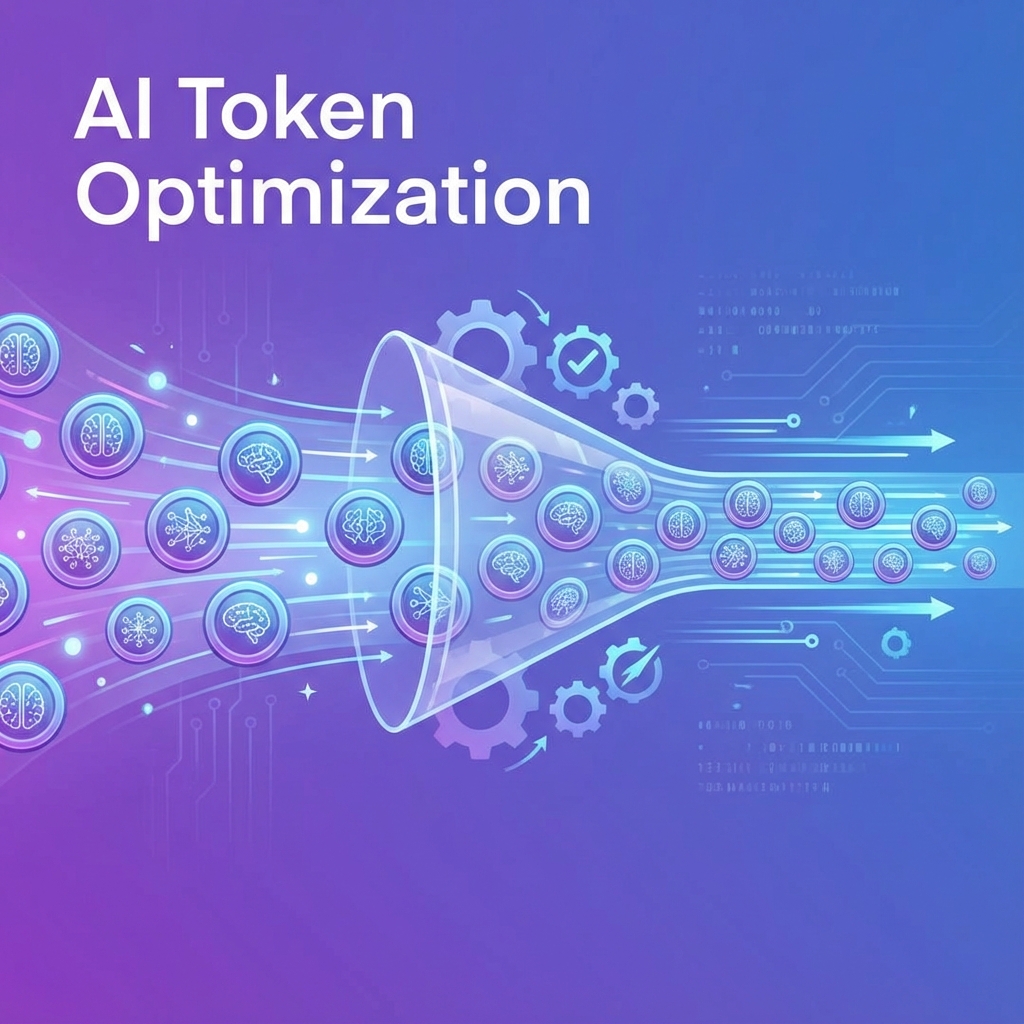
AI Token Optimization Guide
Tokens are the currency of AI interactions. Understanding how they work—and how to minimize usage—is essential for anyone building AI-powered applications or using AI APIs at scale.
What Are AI Tokens?
Tokens are the basic units that AI language models use to process text. They're not exactly words or characters, but rather pieces of words that the model has learned to recognize.
Token Examples
| Text | Approximate Tokens |
|---|---|
| "Hello" | 1 token |
| "Hello, world!" | 3 tokens |
| "Artificial Intelligence" | 2-3 tokens |
| "supercalifragilisticexpialidocious" | 8+ tokens |
The 4-Character Rule
A common rule of thumb: 1 token ≈ 4 characters for English text, or about 0.75 words per token.
Why Tokens Cost Money
AI providers charge based on token usage because:
- Computational Cost - Processing each token requires GPU resources
- Model Training - The model was trained on tokenized data
- Memory Usage - Tokens occupy space in the model's context window
Token Pricing Across Providers
Different AI providers have different pricing models:
OpenAI (GPT-4)
- Input: ~$0.03-0.06 per 1K tokens
- Output: ~$0.06-0.12 per 1K tokens
Anthropic (Claude)
- Input: ~$0.008-0.015 per 1K tokens
- Output: ~$0.024-0.075 per 1K tokens
Google (Gemini)
- Varies by model and tier
- Often includes free tiers for development
Pricing as of 2024. Check provider websites for current rates.
Token Optimization Strategies
1. Compress Your Prompts
Remove unnecessary words and phrases:
- Filler words ("please," "just," "basically")
- Redundant instructions
- Excessive formatting
2. Use System Messages Efficiently
System messages persist across a conversation. Keep them concise:
Inefficient:
You are a helpful assistant. You should always be polite and professional. When answering questions, you should provide detailed and accurate information. Please make sure to explain things clearly.
Optimized:
You are a helpful, professional assistant. Provide detailed, accurate, clear explanations.
3. Limit Response Length
Use instructions or parameters to control output length:
- "Respond in 2-3 sentences"
- Set
max_tokensparameter - Request bullet points instead of paragraphs
4. Prune Conversation History
For chat applications:
- Summarize older messages
- Remove redundant context
- Keep only relevant history
5. Batch Similar Requests
Instead of multiple API calls:
- Combine related questions
- Process items in batches
- Use single prompts for multiple tasks
Measuring Token Usage
Manual Estimation
- Count words and multiply by 1.3
- Count characters and divide by 4
Programmatic Counting
Most AI providers offer tokenizer libraries:
- OpenAI:
tiktoken - Hugging Face:
transformerstokenizers
Our Free Tool
Use our prompt compression tool to instantly see token counts and potential savings.
Advanced Optimization Techniques
Prompt Templates
Create reusable, optimized templates for common tasks:
[TASK]: {task_description}
[FORMAT]: {output_format}
[CONSTRAINTS]: {any_limitations}
Few-Shot Learning Efficiency
When using examples:
- Use minimal, representative examples
- Avoid redundant demonstrations
- Consider zero-shot for simple tasks
RAG Optimization
For retrieval-augmented generation:
- Limit retrieved chunks
- Summarize context before injection
- Use semantic compression
ROI of Token Optimization
For a business processing 1 million tokens daily:
| Optimization Level | Token Reduction | Monthly Savings* |
|---|---|---|
| Basic (10%) | 100K/day | $50-100 |
| Moderate (25%) | 250K/day | $125-250 |
| Aggressive (40%) | 400K/day | $200-400 |
*Estimated based on typical GPT-4 pricing
Next Steps
- Audit your current prompts and token usage
- Identify high-volume, high-cost operations
- Apply compression techniques
- Measure improvement and iterate
Start optimizing now with our free prompt compression tool →